
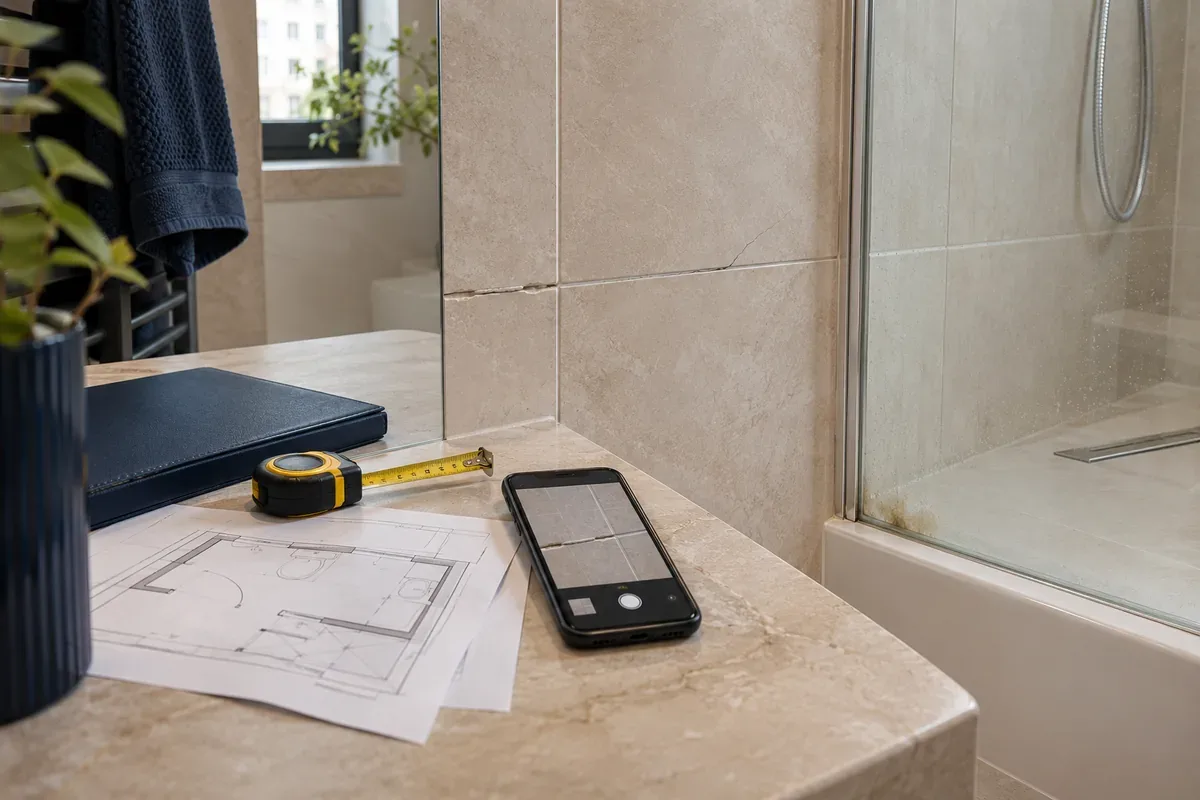
The renovation was supposed to leave you with a finished home, but instead there are uneven tiles, a leaking shower, cracks, a defective installation or unfinished work. In this situation, merely saying that “the renovation was done badly” will usually not be enough. You need to establish what the parties actually agreed, what type of contract governed the works, when the defects became apparent and whether the contractor was given a genuine opportunity to respond.
Not every defect entitles the client to recover all remuneration paid. Depending on the circumstances, the available measures may include remedying defects, completing the works, reducing the remuneration, withdrawing from the contract, substitute performance or claiming damages. Each has different conditions and consequences under Polish law.
No written renovation contract — can a claim still be pursued?
The absence of a single signed document does not automatically mean that no contract was concluded. The agreement may be evidenced by conversations, messages, an accepted estimate, transfers and the manner in which the works were carried out. The difficulty is proving precisely what was agreed.
The following may be particularly relevant in a dispute:
- the offer, cost estimate and work schedule;
- text messages, emails and instant-messenger correspondence;
- invoices, receipts, bank-transfer confirmations and cash receipts;
- photographs and recordings from before the renovation, successive stages and after completion;
- material orders and delivery confirmations;
- testimony from people present during the arrangements or the works;
- acceptance records, defect lists and the contractor’s replies.
A Polish contract for construction works should be evidenced in writing. The absence of written form does not always make the contract invalid, but it may make its terms significantly harder to prove. Even after the renovation has begun, it is therefore sensible to confirm the scope, price, deadlines and acceptance procedure in writing.
A contract for a specific work, a construction works contract or another contract?
The everyday label “renovation contract” does not determine its legal classification. Smaller, distinct works aimed at an identified result may qualify as a contract for a specific work (umowa o dzieło). A larger project carried out in accordance with technical documentation, technical knowledge and the requirements of the construction process may qualify as a construction works contract (umowa o roboty budowlane). Mixed contracts, covering a result, the supply of materials and other services, also occur.
The Polish Supreme Court has indicated that the distinction between a contract for a specific work and a construction works contract depends on the features of the project and its connection with the requirements of construction law, rather than solely on the title of the agreement or the value of the works. The Polish Civil Code also provides for the rules on construction works to apply accordingly to the renovation of a building or structure.
Classification affects, among other things, the exercise of remedies, evidence, acceptance and limitation periods. One should not automatically assume that every tile replacement is a construction project or that every comprehensive renovation is merely a contract for a specific work.
Defects discovered during the works and defects discovered after acceptance
The time when an irregularity is identified matters.
If, while performing a specific work, the contractor proceeds defectively or contrary to the contract, Article 636 of the Polish Civil Code allows the client to require a change in the manner of performance and to set an appropriate time limit. Only after that period expires without effect may the client — if the statutory conditions are satisfied — withdraw from the contract or entrust the correction or further performance to another person at the original contractor’s cost and risk. This rule may apply accordingly to construction works under Article 656 of the Civil Code.
Once the works have been completed and handed over, the analysis shifts towards liability for defects, the terms of the contract and general contractual liability for damages. The remedy in Article 636 should not be mechanically applied to every defect discovered many months after acceptance.
What should you do at each stage of the renovation?
| Situation | Sensible first step | What not to do hastily | Key evidence |
|---|---|---|---|
| The works are ongoing, but the method of performance is defective | Describe the irregularities, require a change in the method and set an appropriate time limit | Do not terminate immediately without checking the legal conditions | Progress photos, a notice setting the deadline and proof of delivery |
| Defects are found at acceptance | Record them, specify the expected repair and deadline | Do not sign an “accepted without reservations” record if reservations exist | Acceptance record, photos and a recording showing how installations operate |
| A defect appears after acceptance | Preserve the condition, report the defect in writing and request a specific action | Do not let another team remove all traces immediately | Chronological photos, the written notification and a technical assessment |
| There is an urgent leak or danger | Limit the damage, document the urgency and keep invoices | Do not wait passively while damage increases | Video, emergency report and invoices for essential measures |
This table organises the first steps; it does not replace an assessment of the contract and the nature of the defect.
What remedies may be available?
Remedying defects or completing the works
Asking the contractor to remedy defects is often the first measure, but the request should identify the particular defects and set a reasonable time. Instead of a general statement such as “please fix the bathroom”, list the irregularities, attach photographs and describe the expected result.
For a contract for a specific work, Article 638 of the Polish Civil Code provides for the statutory warranty rules governing sales (rękojmia) to apply accordingly. Liability for defects in an object completed under a construction works contract is addressed through the corresponding application of the rules on a specific work under Article 656. The scope of a particular remedy must nevertheless take account of the character of the works and the fact that the sales provisions apply accordingly, not mechanically.
Reduction of remuneration
A reduction of remuneration may be considered where the completed result is defective and the statutory requirements are met. The amount should not be arbitrary. Relevant factors may include the relationship between the value of the defective and compliant works, the cost of restoring compliance and the effect of the defect on the usability and durability of the renovation.
A remedial estimate may be important evidence, but it does not always determine the amount of the reduction on its own. Repair cost, the reduction in value and the amount of loss are separate concepts that may produce different calculations.
Withdrawal from the contract and repayment
Repayment of all remuneration is not an automatic consequence of every defect. Withdrawal requires a legal or contractual basis and compliance with the appropriate procedure. Under the statutory warranty regime, withdrawal is generally unavailable where the defect is immaterial. In other situations, it may be necessary first to set an additional period for performance and warn that withdrawal will follow if the period expires without performance.
Effective withdrawal creates restitution duties on both sides. Where renovation work has been permanently incorporated into a home, unwinding the parties’ performances may be more complex than returning an ordinary purchased item. Before making such a statement, its basis, scope and likely consequences should be checked.
Damages
In addition to remedies concerning the defects themselves, a damages claim may arise. Under Article 471 of the Polish Civil Code, a debtor is liable for loss caused by failure to perform or improper performance of an obligation unless the failure results from circumstances for which the debtor is not responsible.
It is necessary to establish at least improper performance, loss and a causal link between them. The loss may include, for example, justified diagnostic and essential repair costs or damage to other parts of a home caused by a leak. Not every expense incurred after a dispute with a contractor will automatically be recoverable.
Can another team be hired at the first contractor’s expense?
This should not be done automatically. While a specific work is still being performed, Article 636 lays down a sequence: a demand to change the manner of performance, an appropriate deadline, and only after that deadline expires without effect the possibility of entrusting correction or further performance to another person at the contractor’s cost and risk.
In other circumstances, Article 480 of the Polish Civil Code may apply. As a rule, carrying out an act at the debtor’s expense requires court authorisation. An exception exists in urgent cases, when the creditor may act without that authorisation while retaining the claim for damages. Urgency must be capable of proof — for example, the immediate need to stop a leak damaging the flat below.
The particular contract may also contain relevant terms. Removing all defects too quickly can deprive the original contractor of an opportunity to inspect them and make it harder to prove the original condition or the necessity and scope of the remedial works.
The contractor is not responding — how should a formal notice be prepared?
The notice should be unambiguous. It is useful to include:
- the parties and the contract concerned;
- an exact description of the defects, preferably in a numbered list with attachments;
- the requested action, such as remedying particular defects;
- an appropriate deadline and a method for arranging access to the property;
- the further measures that may be considered if the deadline expires without effect, without making threats unsupported by law;
- the date and signature.
The notice should be sent in a manner that makes its content and delivery provable. Registered delivery, hand delivery against receipt or an electronic message may be useful if the address and receipt can be established. A screenshot of an unsent message does not prove that the contractor had an opportunity to read it.
How should evidence be preserved before remedial work?
Documentation should be prepared before another team removes the tiles, repairs an installation or covers the source of a leak.
- take overview photographs and close-ups, preferably with dates and a scale reference;
- record the operation of elements with dynamic defects, such as a drain, door or heating system;
- retain the original files rather than only versions sent through a messenger service;
- prepare a chronology of works, payments, complaints and replies;
- invite the contractor to inspect and record the proposed appointment;
- consider a private assessment by a properly qualified professional and a remedial cost estimate;
- if the evidence may quickly disappear, consider an application to a Polish court to secure evidence.
A private expert report does not automatically replace a court-appointed expert opinion, but it may help identify the defects, their likely causes and the required repairs. The expert should receive the contract, technical documentation and progress photographs so that the assessment is not limited to the visual result.
Acceptance and the acceptance record — does a signature end all claims?
Signing an acceptance record does not always exclude claims for defects, particularly latent defects discovered later. The content of the document is nevertheless important evidence. Visible defects should be listed, the scope of reservations stated, and a client should not confirm that the works were completed “without reservations” if that is untrue.
Not every minor defect justifies refusing acceptance of the whole project. Conversely, a material defect that prevents ordinary use or shows that the essential scope remains incomplete may call for a different assessment. The record should distinguish unfinished work, material defects, minor defects and disputed items.
Consumer and business-to-business relationships
If a homeowner commissions a business to renovate a private home, the homeowner will generally act as a consumer. Excluding or limiting statutory warranty liability towards a consumer is permitted only in circumstances specified by special provisions.
In a relationship between businesses, the agreement may more broadly modify or exclude statutory warranty liability. A business client should also examine the result in the accepted manner and notify the defect promptly; failure to comply may result in the loss of warranty rights, subject to statutory exceptions. A separate assessment is needed for a sole trader where the contract relates to the business but is not professional in character for that person.
General contractual liability, any guarantee and the wording of the agreement still require examination independently of the statutory warranty. A notice template drafted for a consumer should therefore not be applied unchanged to a B2B dispute.
Limitation periods and statutory warranty — why is there no single deadline?
Three different matters are often confused in renovation disputes: the period within which a defect must be identified, the period for exercising a particular statutory warranty remedy and the limitation period for claims arising from the contract or for damages.
Claims arising from a contract for a specific work are generally time-barred two years after the work is handed over or, if it was not handed over, from the date on which it should have been handed over. Claims under a construction works contract are generally subject to the ordinary limitation rules. Their length depends, among other things, on who brings the claim and whether it is connected with a business activity.
The statutory warranty rules applicable accordingly to defects in a specific work have their own time limits and mechanics. The running of time may depend on the remedy, the date the defect was identified, the parties’ status and the steps taken after discovery. In B2B contracts, duties to inspect and notify promptly and contractual limitations of liability may also be relevant.
For this reason, reporting a defect should not be postponed merely because an online source mentions a general period of “two” or “five” years. The type of contract and the basis of the particular claim must first be established.
Example: a leak after a bathroom renovation
A flat owner commissioned a comprehensive bathroom renovation. The scope was recorded in an estimate emailed by the contractor. After acceptance, damp appeared on the ceiling of the flat below. Another team suspected that the waterproofing layer beneath the tiles was discontinuous. For two weeks, the original contractor kept saying that he would “come when he had time” but did not offer an appointment.
The owner should not begin by immediately removing the entire bathroom without documentation. A sensible sequence may include:
- stopping the use of the source of the leak and taking essential measures to prevent the damage increasing;
- photographs, recordings, dated notes and documentation of the damage below;
- a written demand inviting the contractor to inspect and remedy identified defects within an appropriate period;
- a technical assessment of the cause of the leak and the necessary scope of work;
- retaining estimates, invoices and elements revealed during opening-up works;
- only then selecting the appropriate claim and determining whether essential works can be entrusted to another team.
If the failure requires immediate intervention, safety and mitigation take priority. It is still important to document why the action was urgent and what work was essential. This example is fictional; the appropriate sequence in a particular case depends on the contract, the type of defect and the scale of the risk.
Document checklist for a defective-renovation dispute
Before a consultation, it is useful to gather:
- the contract, amendments, terms and any guarantee;
- the offer, estimate, project, visualisations and schedule;
- invoices, receipts, bank transfers and cash receipts;
- correspondence with contractors and subcontractors;
- photographs and video from before, during and after the works;
- acceptance records and defect lists;
- formal notices and proof of delivery;
- technical assessments and remedial estimates;
- invoices for emergency work and mitigation;
- a short chronology with dates and the names of people present at important events.
Legal assistance in a dispute with a renovation contractor
A defective-renovation dispute combines contract analysis, technical evidence and the selection of the appropriate remedy. Withdrawing too quickly or entrusting all repairs to another team may complicate recovery of the cost. Conversely, waiting passively while damage grows may also worsen the position.
Angelika Mazur-Kubowicz Law Office assists in Polish civil-law matters concerning contracts, payment and damages in Kraków, Proszowice and Mszana Dolna. Assistance may include reviewing documents, preparing a formal notice, negotiations and representation in court proceedings.
Read about the firm’s assistance in Polish civil and inheritance-law matters.
Prepared on 24 November 2026.
This article is for general information and describes general rules of Polish law. It is not legal advice on an individual matter. The appropriate remedy, deadlines and method of preserving evidence depend on the contract, the nature of the works, the parties’ status and the circumstances in which the defects were discovered.