
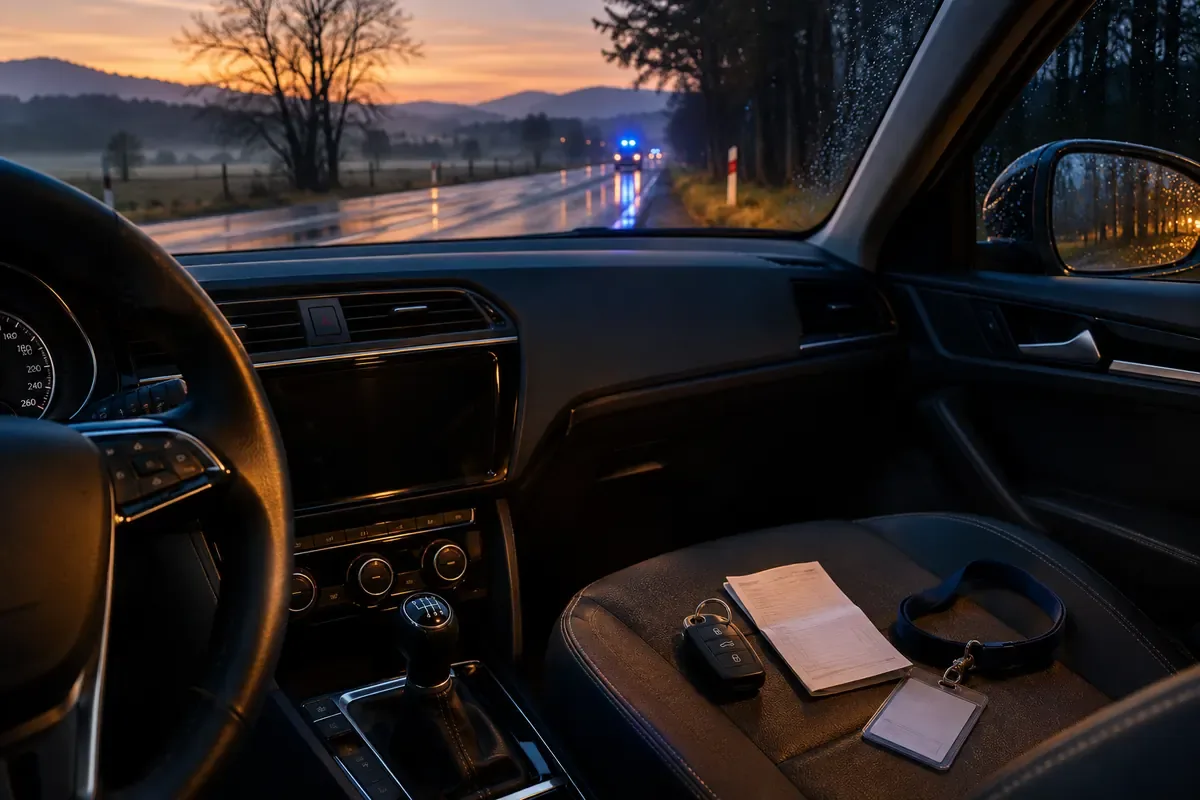
Driving After Alcohol in Poland: Offence or Crime, and What to Do After a Check?
A sobriety check may take only a few minutes, but its consequences can affect a driving licence, employment and finances for years. The legal classification is not determined by the everyday phrase “drink-driving”. It depends primarily on the established alcohol level, the type of vehicle, the sequence of measurements, and any previous convictions or driving bans.
Cases with apparently similar readings may end differently. It may matter whether the readings were rising or falling, when and what the driver consumed, which device was used, and whether the prescribed procedure was followed. This article describes Polish law. It is not a substitute for reviewing the records and case file in an individual matter.
“State after alcohol use” and “state of intoxication” under Polish law
Polish law uses two principal thresholds:
- a state after alcohol use (stan po użyciu alkoholu) exists when the blood alcohol content is from 0.2‰ to 0.5‰, or the breath alcohol content is from 0.1 mg to 0.25 mg per 1 dm³;
- a state of intoxication (stan nietrzeźwości) exists when the content exceeds 0.5‰ in blood or 0.25 mg per 1 dm³ of breath, as well as when it leads to a concentration exceeding those values.
Driving a motor vehicle in a state after alcohol use is generally a petty offence under Article 87 of the Polish Petty Offences Code. Driving such a vehicle in a state of intoxication is a crime under Article 178a § 1 of the Polish Criminal Code.
A result in mg/dm³ should not simply be “doubled” to obtain a value in per mille. These are two different measurement methods. A borderline result requires particular attention to all readings, exact times, measurement uncertainty, the type and condition of the device, and the procedural rules governing the test.
| Established alcohol level | Principal classification for a motor vehicle | Main possible consequences | Sensible first step |
|---|---|---|---|
| Below 0.2‰ or below 0.1 mg/dm³ | Generally below the statutory “after use” thresholds | The reading alone does not establish liability under Article 87 or Article 178a | Keep the printout and review the complete check if the facts are disputed |
| From 0.2‰ to 0.5‰ or from 0.1 to 0.25 mg/dm³ | Petty offence under Article 87 § 1 | Detention or a fine of at least PLN 2,500 and a driving ban | Preserve the protocol, times and every reading |
| Above 0.5‰ or above 0.25 mg/dm³ | Crime under Article 178a § 1 | Up to 3 years’ imprisonment, a driving ban and financial contribution; depending on the case, forfeiture or a compensatory payment | Review the evidence and procedural consequences before giving an explanation |
This table is only a starting point. It does not cover, among other things, a road accident, repeat offending, driving despite a ban, or particular evidential issues.
What happens during a sobriety check?
The check may begin with a screening device and then be repeated with an analyser that produces a numerical result. A blood test is used in certain situations, for example when a breath test cannot be carried out, the driver refuses it, or the result requires verification.
The numbers are not the only relevant evidence. It is worth checking:
- the time of every measurement and the intervals between them;
- whether the readings rose or fell;
- the device identification, valid verification or calibration, and any error messages;
- whether the driver had recently eaten, smoked, used mouthwash, or taken medicine containing alcohol;
- the wording of the protocol, cautions and statements recorded by the officer;
- whether blood was taken and how the samples were secured.
A driving licence may be retained electronically. A receipt does not always authorise further driving, so the absence of a physically seized document does not mean that the entitlement remains exercisable.
The first 24 hours: what should be preserved?
Stress after a check can encourage hasty decisions. It is better to reconstruct the chronology while the details are still fresh.
- Keep all analyser printouts, the test protocol, the licence-retention receipt and the cautions.
- Record the times of drinking, meals, sleep, the start of driving and all tests. Do not adjust the account to fit an expected result.
- Preserve receipts, payment history, messages and details of people who may confirm the chronology.
- Note any medicines and any circumstances that could affect the ability to perform a breath test.
- Do not delete messages or coordinate a “common version” with witnesses. False statements can worsen the position.
- Check the capacity in which you are to be interviewed and the rights available to you, including the right to legal defence and the right to remain silent as a suspect.
Typical sequence of a case
Roadside check → repeat breath tests or blood sampling → licence retention → Police or prosecution steps → procedural decision or charge → court decision → enforcement of the ban and other obligations
Different mistakes can be made at each stage. Receiving correspondence is particularly important. A Polish penal order (wyrok nakazowy) may be issued without a hearing, and the period for filing an objection is generally 7 days from service. The instruction attached to the particular document must always be read.
What are the consequences of Article 178a § 1 of the Criminal Code?
Article 178a § 1 provides for up to 3 years’ imprisonment for driving a motor vehicle while intoxicated. The actual response depends on many factors, including the alcohol level, manner of driving, location and time, distance travelled, previous record and conduct after the event.
On conviction, the court also imposes a driving ban. In a typical intoxicated-driving case, the minimum period is 3 years, and the ban may cover all vehicles or vehicles of a specified type. The court also orders a payment to the Victims’ Support and Post-Penitentiary Assistance Fund: for an offence under Article 178a § 1, at least PLN 5,000.
A conviction may appear in the Polish National Criminal Register until it is expunged. This may be important for occupations requiring a clean record or a particular degree of trust.
Vehicle forfeiture and compensatory payment — rules from 29 January 2026
The vehicle-forfeiture rules have changed. In a case of driving while intoxicated, the court may order forfeiture of the motor vehicle driven by the offender. If the alcohol content was at least 1.5‰ in blood or 0.75 mg/dm³ in breath — or was leading to that level — forfeiture is generally mandatory, unless an exceptional case justified by special circumstances applies.
This does not mean that every car is physically confiscated:
- if the vehicle was not the offender’s exclusive property, the court does not order its forfeiture but orders a compensatory payment (nawiązka) to the State Treasury of between PLN 5,000 and PLN 500,000;
- if forfeiture is impossible or inappropriate for a statutory reason, the court may impose a compensatory payment instead;
- for a leased, rented, company or borrowed car, ownership and the basis of use must be established. One must not automatically assume either forfeiture of somebody else’s car or the absence of serious financial consequences.
The regulation contains exceptions, and the version of the law applicable on the date of the act must be used. An accident, repeat offending or driving despite a ban can change both the basis and scope of liability.
Is conditional discontinuance possible?
Conditional discontinuance of criminal proceedings (warunkowe umorzenie postępowania) is not an automatic entitlement for a first-time offender. The court examines, among other things, whether guilt and social harmfulness are not significant, the circumstances are not in doubt, the offender has not previously been convicted of an intentional crime, and their personal characteristics and previous way of life support a positive prognosis.
The alcohol level, distance and manner of driving, time of day, traffic, reason for driving, and conduct after the check may all matter. Even after conditional discontinuance, the court may impose a driving ban and financial payment. The evidence should be assessed before deciding whether such an application has realistic grounds.
Repeat offending and driving despite a ban
A driver who was previously finally convicted of a specified alcohol-related traffic crime, or who drove during a ban imposed in connection with a criminal conviction, may be liable under Article 178a § 4. The provision carries 3 months to 5 years’ imprisonment and is linked to stricter measures, including, as a rule, a lifetime ban on driving all motor vehicles, subject to a narrow exceptional-circumstances clause.
Separately, failure to comply with a court driving ban may constitute a crime under Article 244 of the Criminal Code. Before returning to driving, it is necessary to check not only the date shown on a document, but also when the judgment became final, how the ban period is calculated, and whether all administrative requirements have been met.
Professional drivers: HGV, bus, courier, taxi and company vehicles
For a professional driver, the case has two parallel dimensions: criminal and occupational. The inability to drive can prevent the performance of core duties even before the proceedings end with a final judgment.
Must the ban cover every licence category?
No one can promise that the court will “leave category C or C+E untouched”. Article 42 § 2 allows a ban covering all vehicles or vehicles of a specified type in relevant cases. The court determines the scope in light of the particular facts. The Polish Supreme Court has emphasised that the wording of the court decision defines the extent to which the administrative authority later withdraws the entitlements.
Arguments about earning a livelihood are relevant to the personal situation, but road safety remains the primary criterion. Private driving outside working hours may also be assessed differently from driving an HGV or bus at work. There is no single rule for every professional driver.
Code 95 and professional qualifications
The EU-harmonised code 95 entry confirms that professional-driver requirements are met for a specified period. A charge under Article 178a does not, by itself, simply and automatically “erase the qualification”. However, retention, suspension or withdrawal of the driving entitlement and the scope of the judicial ban may make lawful professional transport impossible in practice. Medical and psychological examinations, a rehabilitation course and, after a longer withdrawal, a competence test may be required before a return to driving.
Can the employer terminate employment?
The Polish Labour Code permits termination without notice due to an employee’s fault, among other situations, where the employee culpably loses an entitlement necessary for the position. This is not automatic in every case. The legal basis and time of the loss, the employee’s fault, their duties and whether another role is available all require assessment.
If the incident occurred at work or involved a company vehicle, employee liability, vehicle damage, downtime and possible employer claims may also arise. An employee’s position differs from that of a self-employed carrier with contracts and leasing commitments. In a professional-driver case, employment and vehicle documents can be as important as the alcohol-test protocol.
Example: the morning after a family celebration
An HGV driver sets out in the morning in a privately used, jointly owned car after a family celebration. The first reading at 6:48 is 0.29 mg/dm³ and the second at 7:03 is 0.26 mg/dm³. The Police retain the driving licence.
It is not enough to say that “the result was falling” or that the driver felt sober. Both readings exceed the intoxication threshold. The device and procedure, exact times, borderline nature of the second result and all records must be reviewed. In parallel, the possible scope of the ban, effects on work and code 95, and whether joint ownership leads to a compensatory payment rather than forfeiture must be assessed. Only the full picture allows an informed procedural strategy.
What happens to the licence after the case?
After driving while intoxicated or after alcohol use, the Act on Drivers provides, among other things, for a medical examination, a transport-psychology examination and a rehabilitation course on alcohol and drug issues. Where the ban exceeds one year, restoration of the entitlement may require passing a state examination again.
The Polish Executive Criminal Code allows an application to continue serving the ban in a form limited to vehicles not equipped with an alcohol interlock. As a rule, an application may be made after at least half of the ban has been served, or after at least 10 years for a lifetime ban. The court assesses conduct and the road-safety prognosis; the passage of time alone does not guarantee permission.
Documents worth preparing for a consultation
- the test protocol and all analyser printouts;
- the order or receipt concerning retention of the driving licence;
- summonses, cautions, charges, a penal order or indictment;
- blood-test results, if blood was taken;
- a personal chronology with exact times;
- vehicle documents, lease, rental or loan agreement, and details of co-owners;
- previous judgments and information on serving an earlier ban, if this is not the first case;
- for a professional driver: employment contract or service contract, job description, licence categories, code 95 entry, qualification certificate and examination expiry dates;
- correspondence with the employer or customer concerning further work.
When should a lawyer review the case?
Early advice is particularly important for a borderline or inconsistent result, blood sampling, a company or leased car, a previous conviction, an existing driving ban, or where the licence is essential for earning a living. The purpose is not to promise a particular judgment, but to examine the evidence, deadlines and realistic procedural options.
The firm handles matters of Polish criminal law, including the consequences of roadside checks for professional drivers. Assistance is available in Kraków, Proszowice and Mszana Dolna by prior appointment.
This article is general information about Polish law as at 25 November 2026. It is not legal advice in an individual case.